
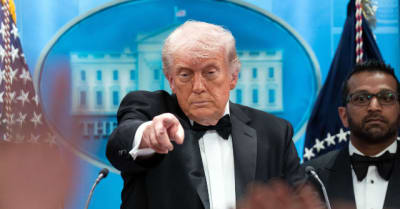
The stark contrast between the nation's reaction to the 1981 assassination attempt on President Ronald Reagan and the recent attack on Donald Trump at the Washington Hilton reveals a troubling evolution in American discourse. Forty-five years ago, a shot fired at the President prompted widespread national mourning and a unified pause in entertainment, exemplified by the Academy Awards postponing its broadcast for 24 hours and the immediate outpouring of support from Hollywood. This week, however, the response was fractured, reflecting a deep and pervasive political polarization that now shapes even our reactions to violence. The very walls of the Washington Hilton, which once echoed with the shock of Reagan's near-fatal shooting, now seem to absorb a different kind of impact: the normalization of extreme rhetoric and its chilling consequences. Cole Tomas Allen, a 31-year-old Cal Tech graduate, allegedly stormed the ballroom where President Trump, Vice President Vance, and numerous other high-profile figures were gathered. His online activity painted a disturbing picture, filled with fervent retweets of content labeling Trump as "literally Hitler" and a manifesto that framed his actions as a defense of democracy. This descent into violence, fueled by an online ecosystem of radicalization, is not an isolated incident but a symptom of a broader cultural decay where political opponents are increasingly dehumanized. The ease with which such extreme viewpoints are amplified online creates fertile ground for individuals like Allen to believe that violent action is not only justified but necessary. This trend is further illuminated by the comments of individuals like Peter Schweizer, who points out the inherent contradiction in demonizing a political figure as a "Nazi" while simultaneously expressing relief that an attacker is "okay." Schweizer argues that such a stance reveals a fundamental dishonesty, suggesting that either the extreme rhetoric is disingenuous or the expressed concern is performative. This intellectual gymnastics highlights how deeply entrenched partisan animosity has become, allowing for the simultaneous embrace of vitriolic language and the pretense of moral consistency. The ability to hold such opposing views without apparent cognitive dissonance speaks volumes about the erosion of shared reality. Beyond the immediate shockwaves of the attack, the incident underscores a disturbing statistic cited by Senator Steve Schmidt: over 25 percent of self-identified "very liberal" individuals now reportedly believe that political violence is a legitimate tool. This is not merely an abstract opinion; it represents a dangerous shift where the foundational principles of democratic discourse are being undermined. When a significant portion of a political group deems violence acceptable, the very fabric of civil society is threatened. Such beliefs, when articulated and amplified by prominent voices, create what some analysts term "permission structures" – environments where violent acts are tacitly endorsed or even celebrated. This environment of escalating rhetoric is not confined to fringe elements. Prominent commentators and podcasters actively engage in or excuse this type of thinking, contributing to a landscape where extremism is normalized. The amplification of such views online, through social media platforms and digital forums, allows radical ideologies to spread rapidly and reach a wider audience. These digital spaces often lack the moderating influences of traditional media, enabling the unchecked dissemination of inflammatory content. The result is a pervasive sense of grievance and hostility that can easily translate into real-world actions, as seen in the Washington Hilton. Compounding the issue is the parallel controversy surrounding the Southern Poverty Law Center, which faces federal accusations of defrauding donors by allegedly using funds meant for progressive causes to secretly support right-wing extremist groups. This revelation, reported alongside the attack, adds another layer of complexity, suggesting that even organizations ostensibly fighting for social justice may be engaging in manipulative practices that contribute to the very polarization they claim to oppose. The potential for financial impropriety within advocacy groups adds a cynical dimension to the already charged political atmosphere. The broader societal implications are profound. When political discourse devolves into a constant barrage of personal attacks, dehumanization, and the tacit endorsement of violence, the foundations of democracy begin to erode. Trust in institutions and in fellow citizens diminishes, making constructive dialogue and compromise nearly impossible. This cycle of animosity and fear can lead to a society where citizens feel increasingly alienated and susceptible to extremist ideologies that promise simple solutions to complex problems, often through violent means. Looking ahead, the crucial question is whether this incident will serve as a wake-up call or simply another data point in an accelerating trend. The ability of political leaders and media figures to condemn inflammatory rhetoric without qualification, and for social media platforms to more effectively curb the spread of extremist content, will be vital. Observers will be watching to see if there are concrete steps taken to address the root causes of radicalization and to foster a more civil public square, or if this moment, like so many before it, will fade into the background noise of an increasingly volatile political climate.
In Brief
An in-depth investigation into how inflammatory rhetoric and online radicalization have escalated political tensions, leading to real-world violence and a fractured national response.Advertisement




Comments
No comments yet. Be the first to comment!