
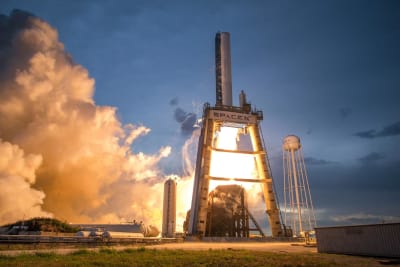
The skies over South Texas recently bore witness to a monumental event in the ongoing saga of private spaceflight: SpaceX's twelfth test flight of its gargantuan Starship rocket. This latest iteration, designated V3, represents a significant evolutionary step, not merely an incremental upgrade, but a complete redesign aimed at paving the way for operational missions. The successful, albeit not entirely flawless, suborbital journey is the culmination of years of relentless development and a testament to the company's iterative engineering philosophy, pushing the boundaries of what's possible in reusable heavy-lift launch systems. This flight was particularly noteworthy as it was the first for the V3 variant, a clear signal that SpaceX is rapidly moving beyond experimental prototypes towards a more refined and robust vehicle. To truly appreciate the significance of this launch, one must look back at the foundational principles that have guided SpaceX since its inception. Elon Musk founded the company with the audacious goal of making humanity a multi-planetary species, a vision inextricably linked to drastically reducing the cost of space access. Early successes with the Falcon 9 and Dragon capsules proved the viability of reusable rocket technology, a paradigm shift that dramatically lowered launch expenses. Starship, however, is on an entirely different scale. It's not just about reaching orbit; it's about transporting massive payloads and large numbers of people to the Moon, Mars, and beyond. The V3's redesign, featuring a novel hot-staging mechanism and a more integrated interstage structure, reflects the lessons learned from previous Starship test flights, each of which provided invaluable data, even in failure. This persistent drive to learn and adapt, even when faced with setbacks like an engine shutdown during ascent, is a hallmark of SpaceX's ambitious approach. The V3's suborbital Flight 12, launched from a newly constructed second pad at the Starbase facility, encountered its share of challenges. During liftoff, one of the 33 Raptor engines on the Super Heavy booster experienced an anomaly and shut down prematurely. Furthermore, the booster failed to execute its critical "boost back" maneuver, a controlled return to Earth designed to bring it back for recovery. The Starship upper stage, Ship 39, also lost one of its six main engines during its climb into space. Despite these issues, the upper stage managed to reach its intended altitude on the remaining engines, a testament to the vehicle's redundancy and robust design. SpaceX spokesperson Dan Huot acknowledged the deviations from a nominal flight path, stating that the trajectory was "within bounds" and that the team was actively analyzing the data, underscoring the experimental nature of these tests. The public and social media reaction to the launch was, as expected, a mixture of awe and intense scrutiny. Live streams of the launch attracted millions of viewers worldwide, with platforms like X (formerly Twitter) buzzing with commentary. While many celebrated the sheer spectacle and the progress made, others focused on the engine failures and the deviation from the planned flight profile. Elon Musk himself chimed in on X, calling it an "epic first Starship V3 launch & landing!" and a "goal for humanity," a sentiment echoed by many enthusiasts. However, critics and even seasoned space observers pointed to the persistent technical hurdles, raising questions about the timeline for operational missions and the significant investment required to overcome these challenges. The economic and political ripple effects of Starship's development are profound. A fully operational Starship system promises to revolutionize space logistics, enabling cost-effective lunar missions for NASA's Artemis program and paving the way for potential asteroid mining and extensive space tourism. The technological advancements spawned by Starship's development also have broader implications, spurring innovation in materials science, advanced manufacturing, and propulsion systems. Politically, the success of Starship bolsters American leadership in the new space race, fostering competition and collaboration with international partners. The sheer scale of the Starship program, however, also necessitates substantial financial backing, making its progress a closely watched indicator of private investment trends in the aerospace sector. Looking ahead, the Starship program faces a critical juncture. The successful completion of V3's suborbital flight, despite its imperfections, allows SpaceX to gather crucial data on the redesigned systems. The immediate focus will undoubtedly be on analyzing the anomalies encountered, refining the engine performance, and improving the booster's recovery sequence. Future test flights will likely continue to push the envelope, aiming for orbital insertion and, eventually, a full-duration flight with a successful splashdown or landing. The company's rapid iteration cycle suggests that further design changes and hardware updates are inevitable before Starship achieves its ultimate goals. The future outlook for Starship hinges on its ability to transition from successful test flights to reliable, operational missions. The next few years will be pivotal. We can anticipate more test flights, each building upon the last, with increasing complexity and ambition. The successful deployment of Starship as a Mars transport system or a lunar lander depends on overcoming the engineering challenges related to sustained flight, orbital refueling, and atmospheric re-entry. The pace of innovation at SpaceX has historically been rapid, but the sheer magnitude of the Starship project means that consistent progress, rather than sporadic leaps, will be key to its long-term success and its impact on the future of space exploration. For the public and potential stakeholders, the next steps to watch involve the frequency and success rate of subsequent Starship V3 test flights. Pay close attention to whether SpaceX can consistently achieve orbital velocity and demonstrate successful booster and ship recovery. The progress in refining the Raptor engines, improving the thermal protection system for re-entry, and demonstrating the capability for orbital refueling will be critical indicators. The company's ability to meet its ambitious timelines for lunar and Martian missions will also be a significant benchmark, signaling the maturity of this revolutionary launch system.
In Brief
SpaceX's latest Starship test flight, featuring a completely redesigned V3, represents a crucial evolutionary step for its ambitious lunar and Mars ambitions. Despite encountering engine issues, the flight provided invaluable data for the company's iterative development process.Advertisement





Comments
No comments yet. Be the first to comment!