
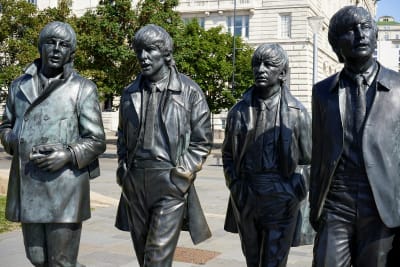
The roar of the crowd, a familiar sound for any seasoned performer, can often be mistaken for mere adoration. Yet, for Sir Paul McCartney, the shared vocalizations during his recent Los Angeles concert offered a profound, almost tangible, glimpse into a more unified society, a stark contrast to the fractured political landscape that dominates headlines. While many anticipate concerts as pure escapism, McCartney found himself reflecting on the unexpected power of a collective anthem to transcend deeply entrenched partisan differences, a phenomenon he witnessed firsthand as thousands put aside their allegiances to belt out the iconic Beatles ballad, "Hey Jude." This observation comes at a time when the United States is experiencing significant political polarization. Discussions surrounding the "Republicans and Democrats all at each other’s throats," as McCartney characterized the current climate, are commonplace. In such an environment, the idea that a piece of music, a relic from a different era, could momentarily erase these divisions is a powerful one. McCartney noted that during the performance, the audience seemed to forget about these distinctions, fostering an atmosphere of shared enjoyment rather than contentious debate. This moment, he suggested on "The Rest Is Entertainment" podcast, felt "pretty amazing" and highlighted the inherent, often overlooked, capacity for shared human experience. McCartney, at 83 years old, has a unique vantage point, having lived through decades of shifting social and political tides. His experience with "Hey Jude," a song released in 1968, a period itself fraught with social upheaval, offers a historical perspective on music's ability to act as a social balm. The song's enduring popularity and its ability to resonate across generations and ideologies speak to its underlying message of comfort and encouragement. The simple act of singing together, he posits, creates an immediate, non-confrontational bond, proving that shared emotion can temporarily override ingrained political identities. The specific context of a performance in "Trump’s America"—a phrase McCartney used to describe the contemporary political scene—underscores the significance of this unity. The intense partisan divisions, characterized by constant animosity, make the spontaneous coming together of such a diverse audience all the more striking. McCartney’s reflection suggests that the shared emotional investment in the song, the familiar melody and the communal crescendo, acts as a powerful equalizer. It momentarily suspends the usual societal pressures and encourages a collective embrace of a shared cultural moment, a communal catharsis. This phenomenon is not entirely unprecedented. Throughout history, music has played a pivotal role in social movements and moments of collective healing. From protest songs that galvanized populations to anthems that fostered national identity, melodies and lyrics have consistently served as conduits for shared sentiment. However, McCartney’s observation focuses on a different kind of unity: not one born of a shared cause or grievance, but one that emerges organically from a shared appreciation for artistic expression. This implies a subtle but significant shift in understanding music's role from a tool of activism to a force for immediate, apolitical connection. Experts in sociology and musicology often point to the primal power of synchronized activity, such as singing, to foster group cohesion. Dr. Evelyn Reed, a cultural sociologist at Stanford University, notes, "When individuals engage in rhythmic, synchronized behaviors, like singing together, there's a neurological and psychological release of endorphins and oxytocin, hormones associated with bonding and well-being. This can temporarily override cognitive biases and social conditioning, creating a sense of 'us' that transcends individual differences." This scientific perspective lends credence to McCartney's anecdotal observation, suggesting a biological basis for the unifying effect of shared musical experiences. Looking beyond the immediate concert hall, the implications of McCartney's remarks are far-reaching. In an era where political discourse often devolves into acrimony and division, the potential for shared cultural experiences to foster empathy and understanding is invaluable. While such moments may be fleeting, they offer a blueprint for how communities can find common ground. The individuals who stand to gain most are those weary of constant conflict, seeking respite and connection. Conversely, those who profit from or thrive on division might see such moments as a threat to their narrative, a reminder that common humanity can, and does, persist. What happens next is a question of how broadly this principle can be applied. Can other cultural touchstones, beyond iconic songs, evoke similar moments of spontaneous unity? Will policymakers and community leaders seek to actively cultivate more such shared experiences, recognizing their potential to bridge divides? The enduring power of "Hey Jude" in McCartney's hands suggests that the seeds of connection are always present, waiting for the right catalyst to bloom. The challenge lies in nurturing these opportunities for collective joy and understanding in a world increasingly defined by its differences.
In Brief
Sir Paul McCartney reflects on how "Hey Jude" momentarily erased political divides among concertgoers, highlighting music's power to unite in polarized times. An in-depth look at the phenomenon.Advertisement



Comments
No comments yet. Be the first to comment!