
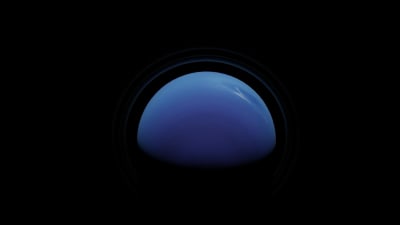
The distant, icy realm of Neptune harbors a peculiar moon, Nereid, whose wildly eccentric orbit has long puzzled astronomers. New analysis using the powerful capabilities of the James Webb Space Telescope suggests this celestial body might be a survivor, a relic from Neptune's very earliest days, clinging to existence after a cataclysmic cosmic event. This revelation challenges previous assumptions about the moon's origins and paints a vivid picture of a solar system far more dynamic and violent in its youth than commonly perceived. For decades, scientists have grappled with Nereid's unusual path around Neptune. Unlike most moons, which follow relatively stable, circular orbits, Nereid traces a dramatically elongated, egg-shaped loop. This extreme eccentricity means the moon swings from less than a million miles from Neptune to a staggering six million miles away over the course of its nearly year-long journey. This behavior is so atypical that it has fueled debate about whether Nereid was captured from elsewhere in the solar system or if it formed in situ, an original member of Neptune's nascent satellite family. Recent observations, leveraging the unparalleled infrared vision of the Webb telescope, have provided crucial compositional data. These findings indicate that Nereid possesses a high ice content, a characteristic that sets it apart from objects typically found in the Kuiper Belt, the frigid reservoir of icy bodies beyond Neptune. This discrepancy strongly implies that Nereid did not originate from this outer region, as some theories proposed, but rather has been a resident of Neptune's gravitational embrace for its entire existence, making it a potentially pristine witness to the planet's formation. The implications of Nereid being an original companion are profound. It suggests that Neptune, like other gas giants, likely formed a retinue of moons early in its history. However, the gravitational chaos unleashed by the arrival of its largest moon, Triton, a massive body thought to have been a rogue planet captured from the outer solar system, dramatically reshaped Neptune's satellite system. Triton's immense influence likely sent many of Neptune's original moons on destructive trajectories, leading to collisions and eventual destruction. Nereid's survival, scientists theorize, was a matter of cosmic luck and orbital mechanics. Its highly elliptical path may have allowed it to evade direct collision with Triton or other debris, effectively becoming a celestial outcast that managed to steer clear of the ensuing mayhem. This perspective transforms Nereid from a mere astronomical curiosity into a rare survivor, an object that has endured billions of years of gravitational upheaval. The public's fascination with space exploration, often amplified through social media, has latched onto this intriguing discovery. Discussions on platforms like X (formerly Twitter) and Reddit often highlight the dramatic narrative of a lone survivor in a chaotic cosmic ballet. Users express awe at the resilience of celestial bodies and the sheer violence that characterized the early solar system, prompting a renewed appreciation for the ongoing scientific endeavor to unravel these ancient mysteries. This story underscores a broader systemic issue in planetary science: our limited direct observation of the outer solar system. Neptune has been visited by only one spacecraft, Voyager 2, in 1989, a mission that provided our initial, albeit brief, glimpse of Nereid. The vast distances and extreme conditions make detailed study incredibly challenging, meaning much of our understanding relies on sophisticated remote sensing, like that provided by the Webb telescope, and intricate theoretical modeling. The limited data underscores the immense value of each new observation and the ongoing need for further exploration. Moving forward, astronomers will undoubtedly focus further Webb observations on Nereid and other Neptunian moons. The goal will be to gather more detailed spectral data to confirm its composition and to refine orbital models to better understand the dynamics of the Neptunian system during its formative period. The quest to understand Nereid's past is intrinsically linked to understanding the broader processes of planetary system formation and evolution in the cold, distant reaches of our solar system and beyond.
In Brief
New Webb telescope data suggests Neptune's moon Nereid is an ancient survivor, not a captured object, offering clues to the planet's violent past.Advertisement





Comments
No comments yet. Be the first to comment!