
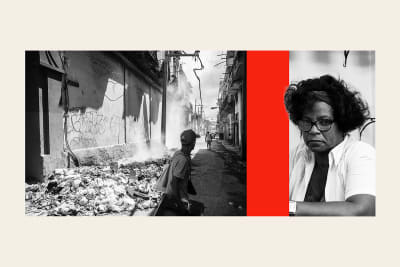
President Donald Trump’s oil embargo against Cuba is putting a severe strain on the nation’s once-renowned free healthcare system, fueling supply shortages that have worsened since the COVID-19 pandemic.
The challenge was recognized by Cuban President Miguel Díaz-Canel during an exclusive interview with Newsweek last week in Havana.
“On the one hand, I acknowledged that we were able to implement a high-quality, free, universal health care system,” Díaz-Canel told Newsweek. “Yet, despite possessing these health care and service capabilities today, more than 90,000 Cubans are on a waiting list for surgical operations, including more than 11,000 children.
“And that hurts, because we have the capacity to do it,” Díaz-Canel said, “but the blockade prevents us from obtaining the supplies and having the energy needed to carry out an operation of that magnitude.”
The crisis runs deeper than an official talking point. The pain is being felt by everyone, from patients to prominent medical professionals and community clinics.
Washington's decades-long trade embargo has long had an impact on its health system, most notably hindering Cuba's ability to bring in specialized medical equipment and parts for certain medicines.
Cuba’s pharmaceutical industry adapted, and grew to be self-sufficient, producing about 3,300 medicines on its own. But it is now "struggling to buy the raw materials needed to manufacture those medicines", says Mitchell Valdes-Sosa, a Chicago-born neurophysiologist and director of the Cuban Center for Neurosciences.
Meanwhile, he argued, high-level research on initiatives, such as a potential treatment for Alzheimer's disease, are also disrupted due to limitations on international partnerships as a result of sanctions.
While the U.S. sanctions policy allows for a humanitarian carve-out that ostensibly covers food and medicine, licenses are granted only on a case-by-case basis, with cash paid up front and no possibility of purchasing through credit.
U.S. sanctions also have an extraterritorial impact. They extend to any foreign U.S. subsidiaries, as well as companies around the world with at least 10 percent of U.S.-origin products. The clause is significant given the globalized nature of the U.S. health industry, especially when it comes to high-end products, some with no substitutes.
Shipping is also a major hurdle. Vessels docking in Cuba cannot port in the U.S. for six months, raising costs and narrowing logistics.
Washington's latest policy, enacted in late January after U.S. forces seized Venezuelan President Nicolás Maduro to face "narco-terrorism" charges in New York, has compounded the problem.
Cuba had been heavily reliant on imported oil to run its ageing grid, given it only produces about 40 percent of its own needs, Havana now finds few partners willing to defy Trump's threats of slapping tariffs against those who step up to aid the island's energy needs, with only a sole Russian tanker arriving late last month.
Fuel scarcities now starve transportation networks relied upon to distribute medicine and other goods to the 10 million Cubans living across the 780-mile-wide island.
“People get desperate, and then people start hoarding medicine,” Valdes-Sosa told Newsweek.
A thriving black market for basic medicines has become entrenched. “With the shortage, some, let's say, smart guys, now they try to work out ways of making money," he said.
“So, the problem is that we manage to manufacture most of the medicines, but it's not as before [when it] continues over the whole year,” he said.
“It's by bursts, and then there's this problem of transferring them to other provinces, so you can have a warehouse full of medicine, and then you're waiting for the gas to take things there.”
The result, he said, “is a problem that's probably also making our health indicators worse,” challenging one of the key achievements of Cuban Communist Party rule since the 1959 revolution.
Critics say the problem lies with the Cuban government. They blame rampant inefficiency and neglect associated with the nation's predominantly state-run governance, which even many Cuban officials acknowledge requires greater improvements.
A U.S. State Department spokesperson argued that Newsweek's interview with "Dictator Diaz-Canel" failed to address the true root of "why his regime has gas and diesel for their repressive security apparatus while Cuba's hospitals lack fuel."
"Despite Cuban regime propaganda, it has chosen for years not to invest in health care and to force the Cuban people to depend on relatives abroad, mostly in the United States, to send them medical supplies," the State Department spokesperson told Newsweek. "This is further proof of the regime’s incompetence, selfishness, and abuse."
"For far too long, the regime has failed to produce an economic system that works or can provide for the Cuban people—stifling growth and prosperity to preserve total regime control on the island," the spokesperson said. "The fuel crisis on the island is because the regime is no longer receiving subsidies from Maduro’s illegitimate Venezuelan criminal organization."
The Trump administration has justified its tariff threat on oil exports to Cuba by arguing the country constitutes a threat to U.S. national security due to its communist policies, relations with Russia, China and Iran, and alleged ties to U.S. designated terrorist groups which Cuba denies.
'It's The People Who Are Suffering'
Newsweek saw the effects firsthand while in Havana, where many pharmacies were closed throughout the day, limited to operating within a window of just two hours. Their shelves are scarcely supplied, and electricity is unpredictable due to a lack of diesel to feed the grid.
Roxana Martinez Rodriguez, a family doctor who oversees nearly 2,000 patients at a small clinic in Central Havana’s densely populated, working-class neighborhood of Cayo Hueso, said issues had been mounting since the COVID-19 pandemic but were now pushing the system beyond its limits.
Monthly shipments to clinics now come every 45 days, "and hardly any medicine arrives”, she told Newsweek.
Meanwhile, basic equipment like X-ray machines are breaking down and authorities can't source the parts to replace them. She recalled one patient who was rushed to the hospital with a heart condition and ultimately could not be saved because they couldn't find a substitute pacemaker.
“The main problem is the blockade, which prevents medicines and the raw materials for producing them from entering,” Rodriguez told Newsweek.
“Usually, even with the blockade, Cuba had and still has labs to make medicines. The raw materials came through a third country, which made them a bit more expensive, but they arrived, and many medicines were manufactured here,” she said.
The prolonged, near-daily blackouts make work even more challenging. While medical institutions are prioritized, dwindling electricity is more readily diverted to large hospitals, with smaller clinics like hers often left in the dark.
The state, which is providing solar panels in a bid to alleviate frequent blackouts, “is trying,” Rodriguez said. “But they can do more.”
While she noted there were outstanding challenges before the latest measures, she added that “under this Trump administration, everything intensified, everything escalated and the situation worsened.”
But the blockade isn't just hurting the government, which the Trump administration has made clear they'd like to see the end of, said Rodriguez.
Rather it’s the people who “endure precarious living conditions because there is simply nothing—no food, no lighting, no water, and they are affected in every way.”
“It’s the people who are suffering,” Rodriguez said, “and it’s the people who are paying the price.”
Read Newsweek's full interview with the Cuban president here.
Update 4/11/26, 2:25 p.m. ET: This article has been updated to include additional context and a comment from a U.S. State Department spokesperson.
In a polarized era, the center is dismissed as bland. At Newsweek, ours is different: The Courageous Center—it's not "both sides," it's sharp, challenging and alive with ideas. We follow facts, not factions. If that sounds like the kind of journalism you want to see thrive, we need you.
When you become a Newsweek Member, you support a mission to keep the center strong and vibrant. Members enjoy: Ad-free browsing, exclusive content and editor conversations. Help keep the center courageous. Join today.


In a polarized era, the center is dismissed as bland. At Newsweek, ours is different: The Courageous Center—it's not "both sides," it's sharp, challenging and alive with ideas. We follow facts, not factions. If that sounds like the kind of journalism you want to see thrive, we need you.
When you become a Newsweek Member, you support a mission to keep the center strong and vibrant. Members enjoy: Ad-free browsing, exclusive content and editor conversations. Help keep the center courageous. Join today.
Comments
No comments yet. Be the first to comment!